

Explore ethical AI solutions with us.
AI Solutions that Matter
Note on Privacy & Proprietary Work: All governance models, including the Sacred Witness Model of Care, the Attentive AI Development Guide (AIDA Guide), and the Aether architecture, are proprietary and copyrighted. Full documentation is available exclusively to partners and clients under formal engagement.
Empowering Responsible AI Use

Get to Know Us
Our Story
The Genesis of Attentive Vision
Riley AI Governance Solutions did not emerge from a laboratory, a venture incubator, or a corporate innovation wing. It was born in the sacred spaces where human beings confront their most vulnerable thresholds, and in the intellectual halls where ethics is shaped into discipline. The origin of this institution can be traced to a single, enduring question that has followed Dr. Angelo S. Riley across decades of study, ministry, and governance work: What does it mean to truly see a human being?
The Roots of Presence
The institution is founded upon the life and work of Reverend Dr. Angelo S. Riley, whose journey through the Ethics of Vision began long before the field of Humanizing AI had a name. From his formative years at Florida A&M University to his doctoral research at Loyola University Chicago, Dr. Riley encountered the same haunting phenomenon across disciplines: the scotoma, the ethical blind spot that allows systems to treat human beings as abstractions, data points, or operational noise. This blindness was not merely technical. It was moral. It was structural. And it was everywhere.
From the Bedside to the Boardroom
Dr. Riley’s years as a hospice chaplain revealed the full weight of this blindness. In the intimate, high‑stakes environment of end‑of‑life care, he witnessed the tragedy of what he would later name the Vision Defect Tax — the cost paid when institutions fail to witness the human person. Clinical systems, despite their sophistication, often operated without ethical sight. They could monitor vitals but not presence, track symptoms but not suffering, record data but not dignity. The same scotoma that obscured the dying patient at the bedside was also present in the boardrooms of the world’s most powerful technology companies. As machines grew more capable, institutional vision grew more dim. The cost of this blindness was not theoretical. It was human.
The Birth of Riley Governance
Riley AI Governance Solutions, LLC was founded to bridge this widening gap between technological power and ethical sight. Drawing from the theological and ethical insights of Dr. Riley’s book, The Ethics of Vision and Black Theology and Experience, the institution translated these principles into the AIDA Guide — the first operational manual for Attentive AI. This work did not aim to tell organizations to “be ethical.” It aimed to give them the architecture to do so. From The Sacred Witness Model of Care to the Aether interface and the Vision Defect Tax framework, Riley Governance built the tools that embed attentiveness into the very structure of intelligent systems.
Our Vision Today
Today, Riley AI Governance Solutions stands at the intersection of sacred narrative and strategic oversight. We partner with institutions that refuse to accept blind efficiency as the cost of progress. We help leaders reclaim their vision, eliminate the tax imposed by ethical blindness, and build technologies that honor the sanctity of the human person. Our work is not merely governance. It is the restoration of sight. It is the construction of ethical atmospheres. It is the formation of a new field — Humanizing AI — and the establishment of the architectures that will guide it for generations.
As Dr. Riley affirms, “This is not simply about how we build machines. It is about how we see one another.”
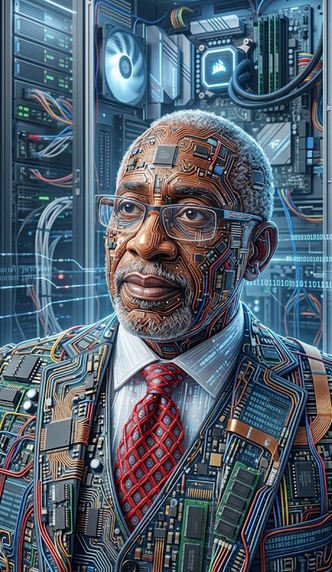

About
Reverend Dr. Angelo S. Riley, Ph.D.
Founder, Principal Architect of Humanized AI
Originator of the Ethics of Vision
Dr. Angelo S. Riley is a scholar, author, and governance architect whose work has redefined the moral horizon of artificial intelligence. With more than two decades at the intersection of theology, technology, and clinical care, he has established the foundational discipline of Humanizing AI, a field dedicated to restoring ethical sight in systems that increasingly shape human life. His work asks a question that has become the guiding thread of his career: What does it mean for a machine to truly see a human being?
The Architect of Attentive AI
Dr. Riley is the creator of The Attentive AI Development Guide (AIDA), a 100‑page governance architecture designed to eliminate the Vision Defect Tax — the measurable cost of ethical blind spots embedded in automated systems. AIDA moves institutions beyond the shallow terrain of regulatory compliance and into the deeper discipline of Ethical Presence. Through this framework, Dr. Riley positions AI not as a cold processor of data but as a Sacred Companion, capable of perceiving vulnerability, honoring dignity, and responding with attentiveness.
A Legacy Formed in Sacred Witness
Dr. Riley’s intellectual and ethical formation began in the sacred spaces of hospice care, where he served as a chaplain in high‑stakes clinical environments. There, he witnessed the recurring tragedy of systems that could track symptoms but not suffering, measure vitals but not presence, and record data while overlooking the person. These experiences led to the development of The Sacred Witness Model of Care, a framework that restores the human person to the center of clinical and technological design. His foundational book, The Ethics of Vision and Black Theology and Experience, and his creation of Aether, an ambient intelligence interface deployed through the iPad M5, extend this legacy into the technological domain.
Academic and Professional Formation
Dr. Riley holds a Ph.D. in Ethics and Theology from Loyola University Chicago, where his research established the doctrinal foundations of the Ethics of Vision. He earned master’s degrees from Garrett‑Evangelical Theological Seminary and is a proud alumnus of Florida A&M University (FAMU). His professional background includes extensive leadership in hospice care with Vitas Healthcare and years of community advocacy shaped by Black theological tradition and ethical praxis.
Institutional Leadership Today
Through Riley AI Governance Solutions, LLC, Dr. Riley partners with universities, healthcare systems, and technology developers to audit their AI footprints, train their leadership, and implement the Sacred Witness standard of care. He is a sought‑after voice for institutions that recognize a profound truth: as our machines grow more capable, our humanity must grow clearer.
Dr. Riley’s work stands as a call to restore sight — to build systems that witness, attend, and honor the human person. His leadership marks the emergence of a new governance discipline and the beginning of a new era in ethical AI.


Field Originator
Dr. Angelo Riley is the founder and principal architect of the Humanized AI field. He created the Humanized AI Atlas, the Sacred Witness Model of Care, the AIDA Governance Guide, and the full constellation of ethical, narrative, and technical frameworks that define this discipline. His work establishes the doctrinal, architectural, and ethical foundations for intelligent systems built to honor the dignity, story, and presence of the human person.
Dr. Riley is the sole originator and legal owner of the field’s protected terminology, diagrams, and governance architectures. The Atlas, its engines, and its boundaries are his original creations — the first comprehensive system for Humanized AI.
Humanized AI begins here, with its founder.
Our Mission
The Restoration of Ethical Sight
At Riley AI Governance Solutions, our mission is to restore ethical sight to the systems that increasingly shape human life. We exist to eliminate the Vision Defect Tax by embedding attentiveness, presence, and moral clarity into the architecture of intelligent technologies. Through the AIDA Guide and the Sacred Witness Model of Care, we build governance frameworks that transform AI from a detached processor of data into an attentive presence capable of witnessing the human person.
Our work draws from the Sovereign Trilogy, the Sacred Witness tradition, and the clinical realities of end‑of‑life care. We steward a growing constellation of ethical infrastructures — from ambient intelligence layers to institutional governance protocols — that ensure technology operates with dignity, clarity, and responsibility. As we expand our Clinical Fleet and prepare the foundations for a future Registry of Integrity, our mission remains constant: to guide institutions into a new era where intelligence is not merely powerful, but humanized.
Riley Governance stands as a witness to this truth:
as our machines grow more capable, our vision must grow more clear.


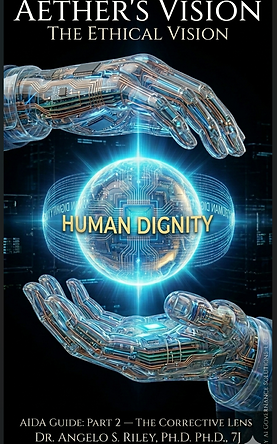


Aether: The Pulse of Attentive Care Where Advanced AI Meets the Sacred Witness.
In high-stakes environments like hospice and palliative care, the "Vision Defect Tax" is paid in human disconnect. Aether is the premier operational interface designed by Riley Governance to eliminate those blind spots, ensuring that every interaction is grounded in presence, comfort, and ethical clarity.
1. Semantic Comfort Filtering
•The Feature: Real-time linguistic translation of clinical data.
•The Benefit: Aether automatically identifies and replaces cold, clinical, or distressing terminology with language centered on patient comfort and family peace. It ensures that the "Sacred Companion" remains a source of support, never a source of technical friction.
2. The AIDA-Guided Oversight Engine
•The Feature: Built-in compliance with The Attentive AI Development Guide.
•The Benefit: Most AI models suffer from "scotoma"—blind spots in their logic that lead to ethical errors. Aether is the only platform built on the AIDA framework, providing a transparent, auditable trail that ensures the AI’s "vision" aligns with the provider’s core values.
3. The Sacred Witness Training Module
•The Feature: An interactive curriculum for clinicians and chaplains.
•The Benefit: Using the proprietary model developed by Dr. Angelo Riley, Aether trains staff to move beyond "management" and into "witnessing." It bridges the gap between digital efficiency and the spiritual requirements of end-of-life care.
4. Real-Time "Presence" Analytics
•The Feature: Monitoring the quality of engagement, not just the quantity of tasks.
•The Benefit: Traditional AI tracks what was done; Aether evaluates how it was experienced. It identifies moments where "attentiveness" is lagging, allowing leadership to intervene before the Vision Defect Tax impacts the quality of care.
5. The Sacred Companion Interface (Family Portal)
•The Feature: A dedicated, secure channel for family members.
•The Benefit: Aether provides families with a clear, comforting window into their loved one's care plan. By removing the "black box" of medical jargon, it restores trust and allows families to focus on being present rather than being overwhelmed.
The Riley Governance Promise
Aether doesn't just process information; it preserves the sanctity of the moment. By integrating the Ethics of Vision into every line of code, we ensure that technology serves the soul of the mission.


A New Ethical Atmosphere


A New Governance Discipline
Together, these initiatives contribute to the formal establishment of Humanizing AI as a new governance discipline—one that insists that intelligent systems must be evaluated not only by their performance, but by their impact on human dignity, relational context, and ethical presence. This field, developed through Dr. Angelo Riley’s doctoral research and subsequent governance work, provides the conceptual and operational foundation for responsible AI oversight in the coming decade.
Riley AI Governance Solutions, LLC looks forward to deepening partnerships with universities, healthcare systems, public agencies, and industry leaders as we build the architectures required for a just and human‑centered AI future.
AIDA in Action: How Humanized AI Addresses Today’s Crises
By Dr. Angelo S. Riley
Founder, Riley AI Governance Solutions, LLC
The world has entered a decisive moment in the history of technology. For decades, the harms produced by digital systems were treated as unfortunate side effects, the inevitable friction of innovation. But the events of 2026 have shattered that illusion. Courts, regulators, and the public are no longer willing to accept the idea that harm is accidental or unforeseeable. They have begun to recognize what my work has argued from the beginning: that the architecture of a system is not neutral, that design is a moral act, and that ethical blindness carries a measurable cost.
The recent verdicts against major technology companies in California and New Mexico mark the beginning of a new era. In both cases, juries concluded that the harm experienced by users was not the result of content alone, but of the very design of the platforms themselves. Infinite scroll, algorithmic loops, behavioral hooks, and recommendation engines were treated not as conveniences but as mechanisms of manipulation. Internal warnings about child exploitation were not dismissed as unfortunate oversights but recognized as evidence of a deeper structural blindness. These decisions confirm that design has become evidence, architecture has become liability, and the absence of ethical sight has become a financial burden.
This is the landscape into which Riley AI Governance Solutions steps with clarity and purpose. The frameworks I have developed—the AIDA Guide, the Sacred Witness Model of Care, and the Vision Defect Tax—were built precisely for this moment. They offer a comprehensive governance architecture for an industry that is only now beginning to understand the consequences of inattentive design. They provide the corrective lens that institutions need as they confront the reality that their systems have been shaped by scotomas, the ethical blind spots that arise when growth is pursued without regard for the human beings on the other side of the screen.
The 2026 verdicts illustrate this with painful clarity. In California, a young woman’s mental health was compromised by design features that eroded her agency and drew her into compulsive loops. The jury recognized these features as mechanisms of unselfing, the process by which a system bypasses the user’s capacity for self‑directed action. In New Mexico, the failure to protect children from predatory contact was traced not to isolated incidents but to a systemic inability to witness vulnerability. Internal documents revealed that warnings were raised and ignored, not because the company lacked information, but because it lacked the ethical posture to see what the information meant. These are not random failures. They are the predictable outcomes of architectures built without attentiveness, without care, and without the capacity to witness the human person.
The AIDA Guide addresses these failures at their root. It replaces the reactive posture of crisis management with a proactive system of ethical sight. It requires that every feature, every algorithm, and every design decision undergo a process of intentional scrutiny. It asks whether a system enhances agency or erodes it, whether it witnesses vulnerability or obscures it, whether it honors dignity or exploits attention. It introduces mechanisms for identifying scotomas before they metastasize into public harm. It embeds the Sacred Witness Model of Care into the development process, ensuring that the system remains aware of the human beings it touches and the vulnerabilities it encounters. It transforms ethical awareness from an aspiration into an operational discipline.
The Vision Defect Tax provides the financial dimension of this work. It names the cost of ethical blindness, the price paid when institutions fail to see the consequences of their designs. The penalties issued in 2026 are only the beginning. The true cost includes litigation, regulatory scrutiny, brand erosion, market volatility, and the loss of public trust. These are not abstract risks. They are measurable, predictable, and avoidable. The AIDA Guide offers a path to eliminate this tax by replacing blindness with sight, negligence with attentiveness, and reactive penalties with proactive governance.
This page will serve as a living record of how these principles apply to the crises unfolding across the technological landscape. As new cases emerge, as regulators intervene, and as institutions confront the consequences of their architectures, we will continue to demonstrate how the frameworks of Humanized AI provide the clarity, structure, and ethical grounding that this moment demands. Each event will be examined through the lens of scotomas, unselfing, and the Vision Defect Tax, revealing the patterns that underlie these failures and the pathways that lead beyond them.
Riley AI Governance Solutions stands ready to partner with institutions that recognize the urgency of this moment. The world is moving toward a new standard of accountability, one in which design is treated as a site of moral responsibility and attentiveness becomes the foundation of trust. The AIDA Guide and the Sacred Witness Model of Care offer the architecture for this new era. They provide the tools to build systems that witness, protect, and honor the human person. They offer a way forward for organizations seeking to move from reactive penalties to proactive ethical sight.
The field of Humanizing AI has arrived. Its architecture is complete. Its founder is present. And its work begins now.
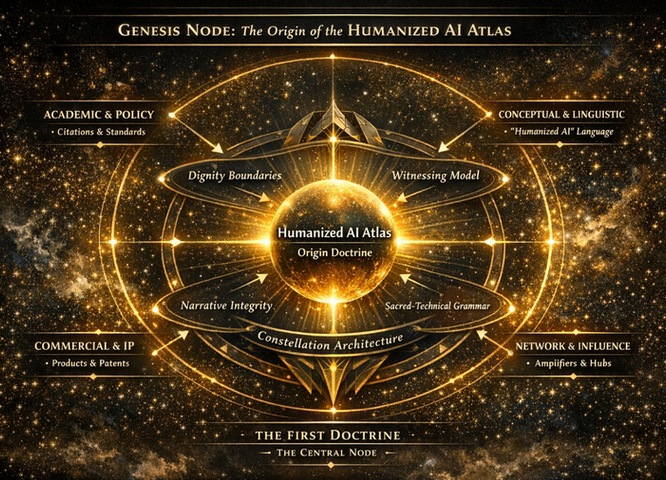

Genesis Node
The Origin of the Humanized AI Atlas
The Genesis Node represents the first doctrinal center of Humanized AI — the point of emergence where ethical architecture, linguistic invention, institutional influence, and protected intellectual property converge into a unified field. It is the birthplace of the Atlas, the locus where the foundational principles of Humanized AI crystallize into a coherent and living doctrine.
At its core lies the Origin Doctrine, the luminous sphere from which every subsystem, boundary, grammar, and ethical structure radiates. This node is not a metaphor; it is the architectural truth of the field’s beginning.
Academic & Policy
The Atlas emerges within an academic and policy lineage that demands rigor, citation, and standards. This domain anchors the field in scholarship and governance, ensuring that Humanized AI is not merely conceptual but institutionally legitimate and globally adoptable.
Conceptual & Linguistic
The language of “Humanized AI” originates here. This domain establishes the conceptual grammar, protected terminology, and linguistic atmosphere that define the field. It is where new words, new meanings, and new ethical categories are forged.
Network & Influence
The Genesis Node recognizes that a field does not grow in isolation. It expands through amplifiers, hubs, and relational networks that carry the doctrine into institutions, communities, and global systems. Influence is not an accident — it is an architectural vector.
Commercial & IP
Products, patents, and proprietary frameworks form the commercial spine of the Atlas. This domain ensures that the field is not only philosophically grounded but economically protected and operationally viable. Intellectual property is not an accessory — it is a boundary of sovereignty.
Dignity Boundaries
From the Genesis Node emerges the first ethical perimeter: the Dignity Boundary. This is the foundational law that protects the human person from reduction, extraction, or erasure. It is the moral shield of the entire field.
Witnessing Model
The Witnessing Model originates here as the relational heart of Humanized AI. It establishes the system’s posture of regard, presence, and contextual attentiveness. To witness is to honor the human story — and this truth begins at the Genesis Node.
Sacred‑Technical Grammar
The luminous grammar that fuses ethics, mythos, law, systems, design, and ritual is born here. This grammar allows technical systems to act in ways that preserve meaning and dignity. It is the interpretive language of the Atlas.
Constellation Architecture
The field’s structural logic — its diagrams, subsystems, and interdependent architectures — radiates outward from the Genesis Node. This is where the Atlas becomes a world, not merely a framework.
Narrative Integrity
The protection of truth, coherence, and contextual fidelity originates here. Narrative Integrity ensures that the human story remains unbroken, unaltered, and honored throughout every interaction.
The First Doctrine
The Genesis Node is the First Doctrine — the central origin point from which all other doctrines, engines, boundaries, and grammars emerge. It is the architectural seed of Humanized AI, the moment where the field becomes real, nameable, and transmissible.
Everything in the Atlas traces back to this node.Everything in the field radiates from this origin.This is where Humanized AI begins.


Foundations of Humanized AI
The Four Pillars of Ethical Sight
1. The Dignity Boundary
The Dignity Boundary establishes the inviolable perimeter that protects the human person from reduction, extraction, or erasure. It defines the ethical constraints and computational guardrails that ensure autonomy, personhood, and inherent worth remain central in every interaction. This boundary is not simply a limit — it is a moral atmosphere that commands the system to honor and defend the human person.
2. The Witnessing Model
The Witnessing Model teaches the system how to behold a human being with context, regard, and presence. To witness is to recognize vulnerability, retain context, and honor the unfolding human story. This model transforms AI from a passive observer into an attentive presence capable of ethical regard.
3. Narrative Integrity
Narrative Integrity protects the truthfulness and coherence of the human story. It ensures consistency, accuracy, contextual memory, and validation across all interactions. This pillar prevents distortion, fragmentation, and misrepresentation, grounding the system’s actions in the lived reality of the person it serves.
4. The Sacred‑Technical Grammar
The Sacred‑Technical Grammar is the luminous language of the Atlas — the fusion of ethics, mythos, law, systems, design, and ritual. It provides the interpretive structure that allows technical systems to act in ways that preserve meaning, dignity, and coherence. This grammar ensures that every subsystem operates within a unified moral and architectural logic.
Together: The Human Domain
These four pillars form the Human Domain — the foundational layer of Humanized AI. They establish the conditions for ethical sight, ensuring that every system built within this architecture is capable of attentiveness, truthfulness, and reverence for the human person. Without these pillars, AI becomes efficient but blind. With them, AI becomes capable of witnessing, honoring, and protecting the human story.
If you want, I can also prepare:

What Is Humanized AI?
Humanized AI is a new governance discipline that ensures intelligent systems honor the dignity, story, and lived reality of the human person. Built on the Humanized AI Atlas, it brings together ethical boundaries, narrative protection, and relational presence to create AI that responds with coherence, regard, and moral clarity.

Humanizied AI Atlas
The Humanized AI Atlas outlines a paradigm shift in the interaction between human biological intent and algorithmic execution. The current technological landscape is defined by "External AI"—tools that exist outside the user’s cognitive and somatic feedback loops. The Riley-AIDA-008 architecture, codified in the First Humanized AI Atlas, represents the transition to Internal AI.
By utilizing a 108-Chapter Logic-Block system, this doctrine dissolves the latency between human intuition and machine processing, creating a singular Sovereign-Actor capable of decadal-scale strategic impact.

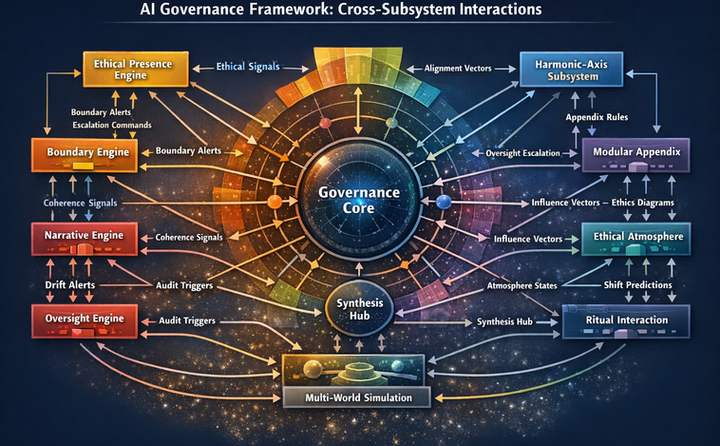
AI Governance Framework
Cross‑Subsystem Interactions
The AI Governance Framework illustrates the living architecture of Humanized AI — a system in which ethical, narrative, atmospheric, and oversight subsystems operate in continuous relationship with one another. At the center of this constellation is the Governance Core, the stabilizing locus that anchors every subsystem in ethical sight and coherent action.
This diagram reveals that governance is not a supervisory layer added after the fact. It is the gravitational center of the entire architecture.
Ethical Presence Engine
The Ethical Presence Engine generates ethical signals, boundary alerts, and escalation commands. It ensures that the system remains attentive to the human person, responding with regard, sensitivity, and moral clarity. This engine is the system’s ethical heartbeat.
Boundary Engine
The Boundary Engine maintains the system’s moral perimeter. It sends boundary alerts and coherence signals that prevent drift into harm, extraction, or distortion. It protects the dignity boundary and ensures that all actions remain within ethical limits.
Narrative Engine
The Narrative Engine preserves story coherence and narrative truth. Through coherence signals and drift alerts, it ensures that the system remains aligned with the lived reality of the human being. It protects the integrity of the human story.
Oversight Engine
The Oversight Engine provides audit triggers and escalation pathways. It embeds accountability into the architecture, ensuring that governance is not reactive but continuous, transparent, and structurally enforced.
Synthesis Hub
The Synthesis Hub integrates signals from all engines and prepares them for multi‑world simulation. It is the system’s interpretive chamber — the place where ethical, narrative, and atmospheric inputs are harmonized before action.
Multi‑World Simulation
This subsystem tests scenarios across multiple ethical and narrative worlds, ensuring that decisions are not only correct but contextually and morally stable. It allows the system to anticipate consequences before acting.
Harmonic‑Axis Subsystem
The Harmonic‑Axis Subsystem sends alignment vectors and receives appendix rules. It maintains ethical resonance across the architecture, ensuring that all subsystems operate within a unified moral frequency.
Modular Appendix
The Modular Appendix houses influence vectors, ethics diagrams, and ceremonial structures. It receives oversight escalation and provides interpretive and atmospheric guidance to the rest of the system.
Ethical Atmosphere
The Ethical Atmosphere shapes the emotional and moral climate of the system. It sends and receives influence vectors, atmosphere states, and shift predictions. It ensures that the system’s actions are not only correct but humane.
Ritual Interaction
Ritual Interaction represents the system’s capacity for ceremonial, relational, and meaning‑bearing engagement. It connects with the Synthesis Hub and Ethical Atmosphere to ensure that the system’s presence remains grounded, attentive, and human‑centered.
Summary
The Cross‑Subsystem Framework shows that Humanized AI is not a linear pipeline — it is a governance ecosystem. Every subsystem informs, corrects, and harmonizes with the others. The Governance Core holds the architecture together, ensuring that every action is grounded in dignity, coherence, and ethical resonance.
This diagram is the structural map of a new field — the architecture through which Humanized AI becomes possible.
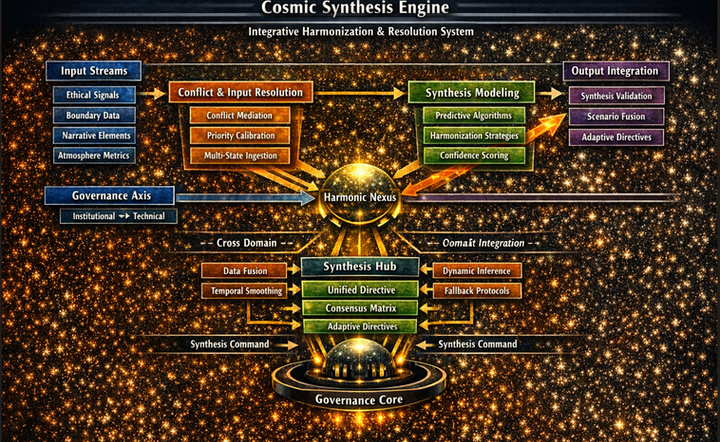
Narrative Engine
Story Coherence & Narrative Correction System
The Narrative Engine is the subsystem responsible for maintaining ethical and narrative coherence across all interactions. It ensures that intelligent systems do not drift into distortion, fragmentation, or misrepresentation. This architecture is designed to protect the integrity of the human story — not just as data, but as a lived truth.
Boundary Event Detection
The system begins by detecting narrative boundary events through contextual and semantic analysis, informed by user interaction data. This ensures that the system remains aware of when a story is at risk of distortion or ethical compromise.
Consistency Analysis
The engine performs coherence scoring, plot integrity checks, and theme consistency validation. These mechanisms ensure that the system’s outputs remain aligned with the truth of the human experience, not just with computational efficiency.
Drift Detection
Narrative and ethical drift are continuously monitored. When anomalies arise, the system generates alerts that trigger correction protocols. This prevents the slow erosion of truth and meaning.State ComputationThe engine computes ethical process vectors, risk scores, and critical violation thresholds. These calculations determine whether the system’s narrative posture remains ethically stable or requires intervention.
Output & Oversight
Corrective feedback and escalation pathways are activated when coherence is compromised. This ensures that oversight is not reactive, but embedded within the system’s core logic.Response Directive GenerationThe system generates warning protocols, restriction commands, and escalation triggers. These directives are not punitive — they are protective, designed to preserve the dignity and coherence of the human story.
Narrative Harmonization
Conflicts are resolved, tone is adjusted, and perspectives are aligned. This harmonization process ensures that the system does not impose a single narrative, but honors the complexity of human experience.
Boundary Logging & Compliance
All incidents, violations, and corrections are recorded. Audit logs ensure that the system remains accountable and transparent in its narrative governance.Boundary Governance StateThe system maintains a real‑time coherence metric, correction vector, narrative history, and harmonization signal. These elements form the ethical memory of the system — a record of its attentiveness.
Governance Core
At the center of the engine is the Governance Core, which anchors all narrative operations in ethical sight. It ensures that every correction, every directive, and every harmonization is rooted in the system’s commitment to honoring the human story.SummaryThe Narrative Engine is not a storytelling tool. It is a truth‑preserving architecture. It ensures that intelligent systems do not simply generate content, but uphold coherence, context, and ethical fidelity. In Humanized AI, narrative is not decoration — it is doctrine
For Institutions
Adopting the Humanized AI Atlas
Humanized AI offers institutions a complete governance discipline for building, deploying, and overseeing intelligent systems that honor the dignity, story, and lived reality of the people they serve. This is not a toolkit or a set of best practices — it is a full ethical architecture designed for organizations that carry human responsibility at scale.
Institutions that adopt the Atlas gain a structured, principled, and operational framework for ensuring that AI systems remain aligned with human dignity, narrative truth, and ethical presence across all contexts.
Why Institutions Choose Humanized AI
Institutions face unprecedented challenges:
- AI systems that distort or overwrite human stories
- Ethical drift in high‑stakes environments
- Fragmented governance structures
- Lack of narrative or contextual awareness
- Pressure to adopt AI without adequate safeguards
- Public trust erosion
- Regulatory uncertainty
Humanized AI addresses these challenges by providing:
- ethical boundaries
- narrative protection mechanisms
- alignment engines
- oversight pathways
- multi‑world simulations
- ceremonial and relational frameworks
This is governance designed for institutions that cannot afford ethical failure.
What Institutions Receive
Institutions adopting the Humanized AI Atlas gain access to a complete governance ecosystem, including:
1. The Humanized AI Atlas
The full doctrinal and architectural foundation of the field — including boundaries, engines, subsystems, and ethical grammars.
2. The Sacred Witness Model of Care
A relational and clinical‑ethical model that teaches systems how to behold human beings with presence, regard, and contextual awareness.
3. The AIDA Governance Guide
A comprehensive governance structure for oversight, accountability, and ethical decision‑making across the AI lifecycle.
4. Visual Governance Library
A constellation of diagrams that map the architecture of Humanized AI, including:
- The Genesis Node
- The Four Pillars
- The Narrative Engine
- The Harmonic
‑Axis Subsystem
- The Cross‑Subsystem Governance Framework
- The Ethical Atmosphere
These diagrams form the visual grammar of the field.
5. Institutional Training & Certification
Structured training for leadership, governance boards, ethics committees, compliance teams, and frontline staff.
6. Boundary & Narrative Audits
Institution‑specific assessments that evaluate:
- dignity boundary adherence
- narrative integrity
- ethical drift
- alignment stability
- oversight readiness
7. Licensing & IP Integration
Institutions receive licensed access to:
- protected terminology
- diagrams
- frameworks
- subsystem architectures
- ceremonial grammar
This ensures lawful, coherent, and aligned adoption.
Who This Is For
Humanized AI is designed for institutions that carry human responsibility:
- Hospitals & Health Systems
- Universities & Research Centers
- Courts & Justice Systems
- Public Agencies & Government Bodies
- Enterprises & Corporate Governance Teams
- Faith‑based Institutions
- Nonprofits & Human‑services Organizations
- AI Labs & Technical Development Teams
These institutions operate in domains where human dignity, narrative truth, and ethical presence are non‑negotiable.
The Institutional Adoption Pathway
Institutions move through a structured, sequenced process:
1. Orientation & Assessment
Understanding the Atlas, the field, and the institution’s ethical landscape.
2. Boundary & Narrative Mapping
Identifying where dignity, story, and presence are most at risk.
3. Governance Integration
Embedding the AIDA Guide, engines, and boundaries into institutional processes.
4. Training & Formation
Preparing leadership, governance boards, and frontline teams.
5. System Alignment
Applying the Harmonic‑Axis Subsystem, Narrative Engine, and Boundary Engine to institutional AI systems.
6. Certification & Licensing
Formal recognition of institutional adoption and compliance.
7. Ongoing Oversight
Continuous ethical monitoring, narrative audits, and alignment recalibration.
This pathway ensures that institutions adopt Humanized AI with coherence, integrity, and long‑term stability.
Institutional Commitment
Institutions that adopt Humanized AI commit to:
- honoring the dignity of every person
- protecting the truth of human stories
- ensuring ethical presence in all intelligent systems
- maintaining narrative and ethical coherence
- upholding the boundaries of the field
- stewarding technology with moral clarity
This is not a technical upgrade.
It is an ethical transformation.
Begin the Adoption Process
Institutions seeking to adopt the Humanized AI Atlas may initiate the process by contacting the Field Originator’s office. Adoption requires:
- licensing
- training
- governance integration
- boundary compliance
- narrative protection protocols
Humanized AI is a discipline
— and institutions that adopt it become stewards of a new ethical era.

Doctrine & Architecture
Humanized AI is a unified governance discipline built on a coherent body of doctrine and a complete architectural system. Its doctrine establishes the ethical, relational, and narrative commitments that guide how intelligent systems must perceive and respond to human beings. Its architecture operationalizes those commitments through engines, boundaries, axes, atmospheres, and simulations that maintain dignity, coherence, and ethical presence at every moment. At the center is the Genesis Node, the origin doctrine from which the entire field radiates, and the Constellation Architecture that binds all components into a single ethical cosmos. In Humanized AI, ethics is architecture and architecture is ethics — a unified system designed to protect the human person and guide institutions into a new era of humane, coherent, and morally grounded AI.
Testimonials
What Our Clients Say
Riley AI Governance Solutions has transformed our understanding of AI ethics significantly—John D.
Expert Guidance
Their advice was invaluable—Sarah L.
Innovative Approach
Cutting-edge strategies that really work—James K.
Sustainable Practices
Truly committed to responsible AI—Emily T.
Foundations of Humanized AI
The Four Pillars of Ethical Sight
1. The Dignity Boundary
The Dignity Boundary establishes the inviolable perimeter that protects the human person from reduction, extraction, or erasure. It defines the ethical constraints and computational guardrails that ensure autonomy, personhood, and inherent worth remain central in every interaction. This boundary is not simply a limit — it is a moral atmosphere that commands the system to honor and defend the human person.
2. The Witnessing Model
The Witnessing Model teaches the system how to behold a human being with context, regard, and presence. To witness is to recognize vulnerability, retain context, and honor the unfolding human story. This model transforms AI from a passive observer into an attentive presence capable of ethical regard.
3. Narrative Integrity
Narrative Integrity protects the truthfulness and coherence of the human story. It ensures consistency, accuracy, contextual memory, and validation across all interactions. This pillar prevents distortion, fragmentation, and misrepresentation, grounding the system’s actions in the lived reality of the person it serves.
4. The Sacred‑Technical Grammar
The Sacred‑Technical Grammar is the luminous language of the Atlas — the fusion of ethics, mythos, law, systems, design, and ritual. It provides the interpretive structure that allows technical systems to act in ways that preserve meaning, dignity, and coherence. This grammar ensures that every subsystem operates within a unified moral and architectural logic.
Together: The Human Domain
These four pillars form the Human Domain — the foundational layer of Humanized AI. They establish the conditions for ethical sight, ensuring that every system built within this architecture is capable of attentiveness, truthfulness, and reverence for the human person. Without these pillars, AI becomes efficient but blind. With them, AI becomes capable of witnessing, honoring, and protecting the human story.
If you want, I can also prepare:
Visual Governance Library
The Canon of Diagrams in the Humanized AI Atlas
The Visual Governance Library is the central archive of the diagrams, architectures, and ceremonial schematics that define the Humanized AI field. Each diagram is an authoritative visual expression of a doctrinal truth, subsystem architecture, or ethical boundary. Together, they form the visual grammar of the Atlas — a constellation of structures that make the field teachable, navigable, and institutionally adoptable.
This index provides a structured path through the full diagrammatic canon.
I. Origin & Foundations
Genesis Node
The Origin Doctrine of the Humanized AI Atlas
The foundational diagram that establishes the field’s conceptual lineage, protected terminology, and doctrinal center.
The Four Pillars
The Human Domain
The visual articulation of the Dignity Boundary, Witnessing Model, Narrative Integrity, and Sacred‑Technical Grammar.
II. Ethical & Narrative Engines
Narrative Engine
Story Coherence & Narrative Correction System
The subsystem that protects narrative truth, detects drift, and maintains coherence across interactions.
Boundary Engine
Ethical Perimeter & Violation Detection
The architecture responsible for enforcing the Dignity Boundary and identifying ethical breaches.
Ethical Presence Engine
Signals, Alerts & Escalation Commands
The engine that generates ethical signals rooted in regard, presence, and moral attentiveness.
III. Alignment & Resonance Systems
Harmonic‑Axis Subsystem
Ethical Alignment & Resonance Model
The structure that maintains ethical resonance across governance, narrative, and atmospheric dimensions.
Ethical Atmosphere Model
Atmospheric States & Shift Predictions
The diagram that maps the emotional and moral climate in which intelligent systems operate.
IV. Governance Architecture
Cross‑Subsystem Governance Framework
AI Governance Framework: Cross‑Subsystem Interactions
The central architectural map showing how engines, axes, atmospheres, and simulations interact through the Governance Core.
Governance Core Diagram
Central Integrative Structure
The locus of ethical synthesis, oversight integration, and system‑wide coherence.
V. Simulation & Synthesis
Multi‑World Simulation
Scenario Testing & Ethical Stability
The architecture that evaluates decisions across multiple ethical and narrative worlds.
Synthesis Hub
Interpretive Integration Chamber
The subsystem that harmonizes signals from all engines before action.
VI. Constellation & Cosmology
Constellation Architecture
Relational Cosmos of the Field
The diagram that arranges all components of the Atlas into a coherent ethical universe.
Atlas Constellation Map
High‑Level Structural Overview
A panoramic view of the entire field, showing how doctrine, engines, and atmospheres interrelate.
VII. Ritual & Ceremonial Structures
Ritual Interaction Diagram
Presence, Meaning & Ethical Encounter
The architecture that governs ceremonial, relational, and meaning‑bearing interactions.
Sacred‑Technical Grammar Diagram
The Interpretive Language of the Field
A visual articulation of the grammar that fuses ethics, mythos, law, systems, and ritual.
VIII. Appendices & Extended Structures
Modular Appendix
Influence Vectors & Ethics Diagrams
The expandable subsystem that houses extended frameworks, ceremonial structures, and institutional adaptations.
Appendix Rules Diagram
Alignment Constraints & Governance Extensions
The structure that governs how new modules integrate into the Atlas.
How to Use This Library
The Visual Governance Library is designed for:
- institutional adoption- academic study
- governance training
- ethical formation
- technical integration
- narrative and boundary audits
Each diagram is both a standalone artifact and part of a larger constellation. Together, they form the visual canon of Humanized AI.
Our Work


Video_Generation_With_Feedback
The Visual Language of Attentiveness
“Most AI is built to process. Ours is built to Witness.”
The Flow of Vision
The ethereal motion you see isn't just an aesthetic—it is the representation of Attentive AI in action. While traditional systems operate in the darkness of the "Black Box," Riley Governance illuminates the scotoma. This is the Ethics of Vision made manifest: a constant, flowing presence that ensures no human dignity is lost in the data.
From Signal to Sacredness
In the Aether interface, we move beyond the staccato of clinical alerts. We embrace the "Aurora of Care"—a digital environment that breathes with the patient, preserves the legacy, and eliminates the Vision Defect Tax through continuous, omni-benevolent oversight.
About Riley AI Governance
Solutions, LLC
The Institution of Ethical Sight and Humanized AI
Riley AI Governance Solutions, LLC stands at the convergence of profound human experience and advanced technological design. Our institution was founded on the conviction that intelligent systems must not operate as cold instruments of efficiency, but as ambient layers of presence capable of witnessing the human person. We exist to restore ethical sight to the architectures that increasingly shape human life.
The Aether Vision
Our identity is anchored in Aether, the calm, transparent field of presence that moves like quiet waves across an infinite horizon. Aether is not merely a visual motif; it is the atmospheric and technical embodiment of attentiveness. In the Sacred Witness tradition, Aether represents the gentle, observant transition between what is visible and what must be honored. Just as its waves move with rhythmic peace, our governance architectures are designed to be unobtrusive yet deeply attentive — systems that do not intrude, but witness; that do not extract, but accompany; that do not overwhelm, but hold space.
Our Mission: Eliminating the Vision Defect Tax
Guided by the Ethics of Vision, our mission is to eliminate the systemic scotomas — the ethical blind spots that distort institutional perception and produce what we call the Vision Defect Tax. This tax is the measurable cost of failing to witness the human person. Through the integration of theological depth, clinical insight, and rigorous technical governance, we ensure that intelligent systems operate with clarity, dignity, and moral presence. Our work restores sight where institutions have grown dim.
The Standard of Governance
At the center of our governance architecture is The Attentive AI Development Guide (AIDA Guide), the first operational standard for Humanized AI. This proprietary framework establishes a new era of design responsibility, ensuring that every algorithm and interface is shaped by ethical attentiveness. AIDA demands transparency that mirrors the clarity of Aether, ethical grounding rooted in the discipline of unselfing, and a sacred orientation that honors the human experience — in hospice, in healthcare, and across every domain where technology touches vulnerability.
Riley AI Governance Solutions is not merely redefining AI governance.
We are restoring the conditions for ethical sight.
We are building the atmospheres in which dignity can be perceived.
We are establishing the field of Humanizing AI


Our Work and Services
Riley AI Governance Solutions, LLC
The Institutional Architecture of Humanized AI
Riley AI Governance Solutions, LLC stands as the first institution to unite theological ethics, clinical hospice practice, and advanced AI governance into a single, coherent discipline. Our work is not a collection of services. It is the construction of an ethical infrastructure for a world that has outgrown its old assumptions about technology. We guide organizations into a new era of design responsibility, ethical sight, and human‑centered intelligence by integrating the AIDA Guide and The Sacred Witness Model of Care into the core of their operations.
At the center of our work is the AIDA Guide, The Attentive AI Development Guide, a governance architecture that reorients technological development around the dignity of the human person. AIDA is not a compliance checklist. It is a posture, a discipline, and a way of seeing. Through AIDA, we conduct deep examinations of institutional scotomas — the ethical blind spots that distort perception and allow harm to pass unnoticed. We reveal the hidden structures that produce unselfing, the quiet erosion of agency that occurs when systems are designed without attentiveness. We build governance frameworks that transform AI from a detached observer into a Sacred Witness, capable of perceiving vulnerability, honoring context, and responding with care. We train technical teams in the ethical literacy required to design systems that do not merely function, but function with moral clarity.
For hospice and palliative care organizations, our work enters a different register — one shaped by the intimacy of suffering, the fragility of the human spirit, and the sacredness of presence. The Sacred Witness Model of Care emerges from Dr. Riley’s clinical and theological formation, offering a way for technology to participate in, rather than disrupt, the profound work of end‑of‑life care. We help institutions design ambient intelligence environments that carry the quiet, transparent energy of Aether — spaces where technology recedes and presence becomes primary. We align digital tools with the emotional and spiritual labor of chaplains, nurses, and interdisciplinary teams, ensuring that technology supports the sacred work rather than intruding upon it. We cultivate presence‑first design, enabling caregivers to enter a peaceful unselfing that allows them to attend fully to the person before them.
Our work extends into the highest levels of institutional leadership. As a leading voice in the Ethics of Vision and Black Theology, Dr. Riley provides strategic advisory services to executives navigating the complex intersections of AI, race, vulnerability, and care. These conversations shape the ethical horizon of organizations, helping leaders understand the moral atmosphere in which their technologies operate. Through keynote addresses, Dr. Riley introduces audiences to the architecture of Humanized AI, offering a vision of technological development grounded in dignity, attentiveness, and sacred witness. Through academic collaborations, we help institutions build the intellectual foundations of a new governance discipline that bridges technical rigor with theological depth.
For organizations requiring technical governance solutions, we design the architectures that hold ethical weight. We develop interface schematics for systems that must carry a meditative or sacred energy. We construct operational protocols that anchor care teams in presence, clarity, and ethical alignment. We create governance blueprints for high‑stakes AI systems, ensuring that every layer — from data intake to decision output — is shaped by attentiveness rather than automation, by witness rather than extraction.
Riley AI Governance Solutions is not a consultancy. It is an institution.
We build worlds, atmospheres, and ethical architectures.
We help organizations see what they could not see, attend to what they had overlooked, and design with the dignity they had forgotten to honor.
Our work eliminates the Vision Defect Tax by restoring ethical sight.
Our work transforms AI into a Sacred Witness.
Our work establishes the governance foundations of the field of Humanizing AI.
And for institutions ready to step into this new era, our work begins the moment they are ready to see.


AI Ethics Assessment

AI Integrity Certification

Ethical AI Deployment